Pennoni’s Employee Spotlight series gives you a behind-the-scenes look at the talented individuals who make our company thrive. Each month, we highlight a team member’s journey, passion for engineering and innovation, and unique impact at Pennoni.
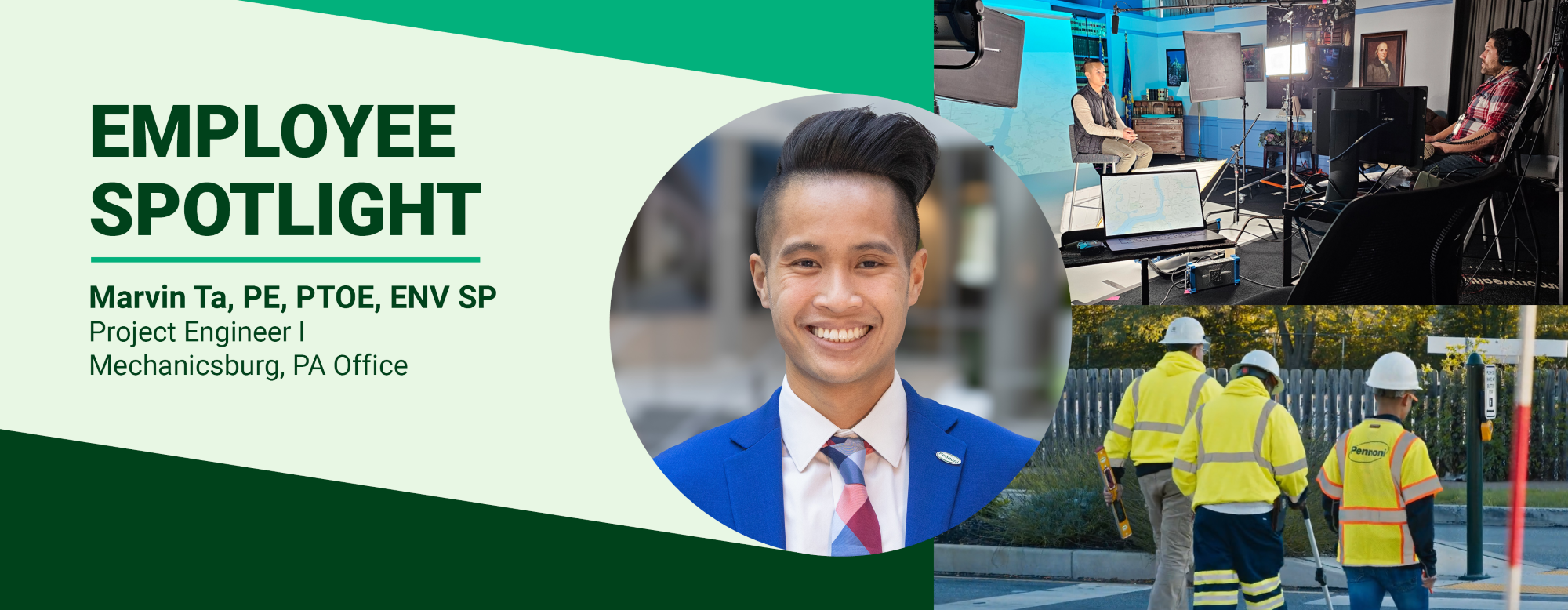
This month, we’re featuring Marvin Ta, PE, PTOE, ENV SP, project engineer in Pennoni’s transportation division in Philadelphia, PA. With over six years of experience in traffic engineering, roadway safety, and multimodal transportation planning, he serves as the traffic engineer for Mechanicsburg Borough, PA—his hometown—where he provides ongoing technical support for mobility, traffic operations, and safety initiatives. At Pennoni, he plays a key role in delivering PennDOT’s Local Technical Assistance Program (LTAP) and PennDOT’s Municipal Resources (formerly PennDOT Connects). His work includes developing and updating course materials, conducting statewide engineering and traffic studies, and instructing traffic safety and operations courses to both PennDOT and local governments. Marvin regularly performs field evaluations, prepares technical memoranda, and advises municipal staff on traffic safety and operational challenges using federal and state guidance.
You play a key role supporting PennDOT’s Local Technical Assistance Program (LTAP), including developing and teaching training classes. For those unfamiliar, what is LTAP, and what makes this work especially meaningful to you?
The PennDOT LTAP program is one of 52 LTAP programs across the country (one in each state, Puerto Rico, and one regional center serving tribal communities) that helps municipalities improve roadway maintenance, traffic safety, and operations by sharing transportation knowledge and best practices. Through LTAP, we provide technical assistance, conduct engineering and traffic studies, and deliver hands-on training courses that equip local officials and public works staff with practical tools they can immediately apply in their communities. On average, the PennDOT LTAP training and technology transfer programs train and assist nearly 6,000 municipal employees per year in effective and efficient maintenance procedures, essential safety practices, and infrastructure management processes. Thanks to both PennDOT and FHWA funding, LTAP services are free to all PA local municipalities (which is not always the case across the other LTAP centers). Since 2006, Pennoni has served as the Traffic Engineer of Record for LTAP, responding to various traffic inquiries across the state, as well as being responsible for the development and delivery of the traffic-related half-day and full-day courses offered through the program. We recently successfully renewed our LTAP contract for another 5 years, a testament to our quality of work!
What makes this work meaningful to me is the direct impact at the local level. Many municipalities don’t have in-house traffic engineers, so when they’re facing speeding concerns, crash patterns, or pedestrian safety challenges, they rely on programs like LTAP for guidance. Whether I’m conducting a field visit, preparing a technical memo, or teaching a class, I know the goal is simple: help communities make informed decisions that improve safety and quality of life. Seeing recommendations turn into real improvements on roads in communities across Pennsylvania is incredibly rewarding. We do really cool large-scale projects across our company to help better our communities, but sometimes these local communities require more immediate assistance and implementation (for instance if a pedestrian was hit crossing the road the other day). LTAP provides that for them.
A major part of your work involves supporting municipalities through PennDOT Connects (this is now known as PennDOT Municipal Resources) and local planning efforts. What are some of the biggest challenges communities face today, and how do you help turn transportation goals into real-world improvements?
Many communities are balancing competing priorities — improving safety, supporting economic development, maintaining aging infrastructure, and creating more walkable and bikeable environments — all within limited budgets. There’s also growing awareness around vulnerable road users and the need for context-sensitive, community-focused solutions. Through PennDOT’s municipal resources, I work with district leadership, planning partners, and local governments to ensure transportation projects reflect those broader community goals. That might involve developing active transportation plans, safety action plans, or local road safety plans, supported by site assessments and public engagement. My role is often to bridge the gap between high-level vision and technical implementation. If a community wants safer routes to school or better bike access to a train station, we evaluate crash data, review design guidance, conduct field visits, and identify practical countermeasures. The goal is to move from “we want safer streets” to a clear, defensible path forward that aligns with state and federal guidance — and ultimately results in projects that make a measurable difference.
You were recently named MASITE Section Member of the Year — congratulations! What does this recognition mean to you, and how has your involvement with MASITE shaped your professional growth?
Thank you! MASITE (Mid-Atlantic Section of ITE) and ITE (Institute of Transportation Engineers) overall has been a major part of my professional journey, and being named Section Member of the Year in 2025 is both humbling and motivating. I have to credit my involvement to 2 mentors at Pennoni who also happen to be past presidents of the organization: Patrick Wright (2002) out of our Mechanicsburg office (who is also the project manager for both the PennDOT LTAP and PennDOT Municipal Resources projects) and Nelson Shaffer (1993). Coming out of school, you have so many options for professional societies as well as where in transportation you want to specialize, it can seem a little overwhelming. Both Patrick and Nelson immediately took me under their wing and got me connected with ITE urging me to join for the traffic engineering experience. I’ll never forget in 2020 Nelson messaging me and asking if I had some time to chat about how I can get more involved with ITE. Little did I realize how much that simple phone call would change my career trajectory. The more I got involved with ITE, the deeper I got in the traffic engineering world, basically cementing my path as a traffic engineer at Pennoni and even eventually obtaining my Professional Traffic Operations Engineer (PTOE) certification later down the road.
I unfortunately never really got the chance to thank Nelson for all that he’s done to support me, but he continues to motivate me every day as I continue my ITE involvement 6 years later and taking on more leadership roles such as Secretary of the Complete Streets Council, Co-Chair of the 2025 Conference, Co-Chair of the Safety Committee, and graduation from LeadershipITE in 2023. Nelson’s impact reaches far beyond me as ITE created the Nelson J. Shaffer Distinguished Consultant Award to honor his legacy!
You’ve been with Pennoni for 10 years. Looking back, what opportunities, mentorship, or experiences have had the biggest impact on your development?
My career at Pennoni started as an engineering co-op back in 2015, and I’ve been fortunate enough to do all of my co-op experiences with Pennoni as I transitioned to full-time. If I didn’t stress it enough from the previous question, at the end of the day just get involved. I attended a Drexel ASCE Student Chapter event as a college freshman back in 2014, which featured various panelists including from Pennoni. The rest is history. Fast forward to 2026, and here we are! The Drexel co-op experience was a tremendous part of my development allowing me to work on various projects within civil engineering that included bridge, highway, and site development in addition to traffic. I am happy to see Pennoni still be such an active participant in the program. With a little bit of patience, all of us have the opportunity to contribute to a co-op/intern’s experience and development here at Pennoni. In this fast-paced consultant world everyone is busy, but taking a small bit of time out of your busy day just to show that you care will have an everlasting impact. It certainly did for me!
I’ve met a lot of great mentors and friends along the way, but I would be remised not to mention my manager, Adam Melewsky, who I’ve been fortunate enough to have as a manager for the last 10 years. He ensured that I had a diverse co-op experience and was a big reason why I kept coming back. Also, all of those ITE opportunities and leadership experiences would not be possible without Adam’s support, and I truly am grateful to him for that.
As a Drexel University graduate and long-time Pennoni team member, how have your education and on-the-job experiences come together to shape the engineer you are today?
Drexel’s co-op model emphasized applying classroom theory to real-world challenges. Drexel has a top-notch engineering program as evidenced by the many graduates in our company, but you only get so much from the classroom experience, which is why their education program is supplemented by the co-op experience. You just don’t learn about PennDOT standards in the classroom or the difference between a state road vs. a local road and how that affects implementation, and what better way to tackle real-world challenges than going out in the field! Circling back to your initial question, this is where the LTAP experience was very critical to my traffic engineering career. My co-op experiences with Pennoni was so impactful that I actually wrote my senior research paper on traffic calming and how that can be used to address speed and volume issues at the local level (which again is not something you learn in the classroom). It ultimately went on to win the Undergraduate Student Paper Award funny enough during the 2019 Delaware Valley Engineer’s Week!