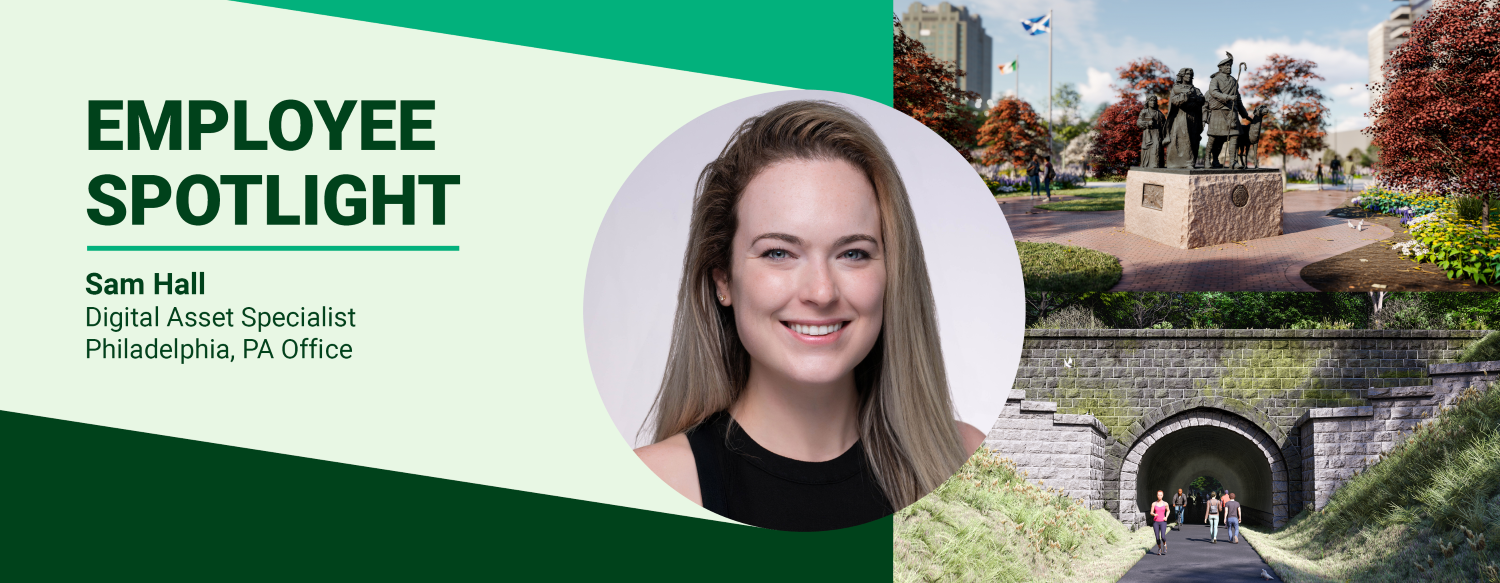
Pennoni’s Employee Spotlight series gives you a behind-the-scenes look at the talented individuals who make our company thrive. Each month, we highlight a team member’s journey, passion for engineering and innovation, and unique impact at Pennoni.
This month, we’re featuring Sam Hall, digital asset specialist in our Philadelphia, PA office. Sam has been with Pennoni for four years, first joining the firm as a design visualization specialist before transitioning to her current role two years ago. In her hybrid position supporting both our PFX and corporate communications teams, Sam creates 3D models, develops photogrammetry-based visualizations and manages Pennoni’s OpenAsset database. A graduate of Drexel University with a Bachelor of Science in Animation & Visual Effects and a minor in marketing, Sam combines creativity and technical expertise to help bring Pennoni’s projects to life and showcase the innovative work happening across the firm.
You’ve been part of Pennoni for the past four years, contributing to projects through digital modeling and visualization. How would you describe your journey with the firm so far, and what continues to excite you about your role?
I started out interviewing and accepting a Drexel co-op role back in 2020, a month before the pandemic shut everything down. While the co-op cycle was disrupted, I kept in touch with a couple of people I had interviewed with. A year later, I was offered the opportunity to complete my co-op while I was finishing up my senior year. After graduation, I spent some time at home and completed a separate internship before being offered a full-time role back at Pennoni, working with PFX. I really enjoyed the people I worked with and the type of projects I worked on during my co-op, so I was excited to return. Since then, I’ve had the opportunity to work on a wide range of projects of varying sizes while continuing to learn new software and skills. That’s part of what keeps this job exciting, and you can see those improvements when you compare renders now to a couple of years ago. More recently, I moved into a hybrid role where I work more closely with the marketing and corporate communications teams, which has been a great experience.
As a Digital Asset Specialist and 3D Artist, you play a unique role in bringing projects to life visually. How does your work support project teams and help clients better understand complex design concepts?
Sometimes it’s hard for people to visualize how plans in front of them will look once everything is built out with all the details. Honestly, before working here, I didn’t always know what I was looking at either. That’s where our work can help. We turn those plans into visuals that are more digestible, so clients and the public can really understand the final product. It also helps get people excited about what’s coming to their community. Hearing that our renderings have helped clients move projects forward and get approval is especially rewarding, and it’s great to know our work is making an impact.
You recently transitioned from working solely within PFX to joining the Corporate Communications team. What has that shift been like, and how has working more closely with marketing and communications expanded or influenced your work?
I’ve really enjoyed getting to know the corporate communications team more through working with them regularly. Everyone helped make me feel welcome and made the transition into this hybrid role much smoother. I’ve also realized just how many different types of projects our firm works on. I knew we did a lot, but not that many. My exposure to the range of disciplines we work in has increased quite a bit, and it’s interesting seeing where the work happens and what it involves. I also still get to work on visualizations with PFX as part of my role, and being able to contribute to both teams is one of the things I enjoy most about my job. Weaving that creative work into my week helps break things up in a way that helps me thrive on both sides.
Your work spans a wide range of projects from infrastructure to public spaces. What types of projects or visual challenges do you find most rewarding, and is there a favorite project or rendering you’ve worked on at Pennoni that really stands out? What made it special to you?
My favorite projects are probably parks or big areas full of fun set dressing, like our work on the I-95 CAP. I enjoy the worldbuilding aspect of visualizations, so projects like that allow me to work on a range of elements, from landscaping to buildings and other details that bring an area to life. One of my favorite projects is the first big project I worked on during my co-op. We put together a large visualization for the City of Newport News for their downtown revitalization project, and PFX didn’t shy away from having me contribute to it. My first assignment for that was working on the seafood market, which didn’t have any design plans, only reference photos of what they may want it to look like. I got to create something entirely new. With a little back-and-forth with the client, we were able to come up with a concept to represent the future market area. That was a memorable experience, especially as a co-op.
From your perspective, what’s one thing that makes Pennoni’s culture unique, especially when it comes to collaboration between creative and technical teams?
Something I’ve noticed about Pennoni is how people-oriented the company is. We have an ESOP program that rewards us for good work throughout the year. When I mention our ESOP to others, many have never heard of one and think it’s very cool that we offer that. I think it’s fair to say we all look forward to seasonal perks that let us enjoy more of the great weather and festivities. These kinds of perks show that Pennoni values its employees, and it reflects in the culture here. When it comes to team collaboration, I’ve seen how our visualizations can influence a project, not just show it. Building plans in 3D can highlight areas that need adjustment that might not have been noticed before. This is where the collaboration between creative and technical teams really shines. We’re able to make those changes in the next round of renderings rather than catching them later in the project, which makes the process feel more hands‑on and fun as we get to help shape the final outcome.